Introduction: The Future Is Not Human Versus AI
Artificial intelligence is transforming the modern workplace. From automating repetitive tasks and generating content to analyzing massive datasets and assisting with complex technical processes, AI is changing how businesses operate, how employees perform their jobs, and how organizations approach innovation.
What once required hours of manual effort can now be completed in minutes. Tasks that previously demanded specialized technical knowledge are becoming more accessible through AI powered tools. Businesses can produce more content, process information faster, improve workflows, and make data driven decisions with unprecedented efficiency.
These developments have raised an important question: If artificial intelligence can perform so many tasks traditionally handled by humans, will it eventually replace the human workforce?
The answer requires a deeper understanding of what intelligence actually means.
AI can process information, recognize patterns, generate predictions, and perform tasks with remarkable speed. However, performing a task is not the same as understanding its full significance. Generating an answer is not the same as knowing whether that answer is appropriate. And producing a result is not the same as accepting responsibility for its consequences.
Human intelligence encompasses more than the ability to process information. It includes reasoning, emotional understanding, moral judgment, creativity, social awareness, and the ability to make decisions when information is incomplete or circumstances are constantly changing.
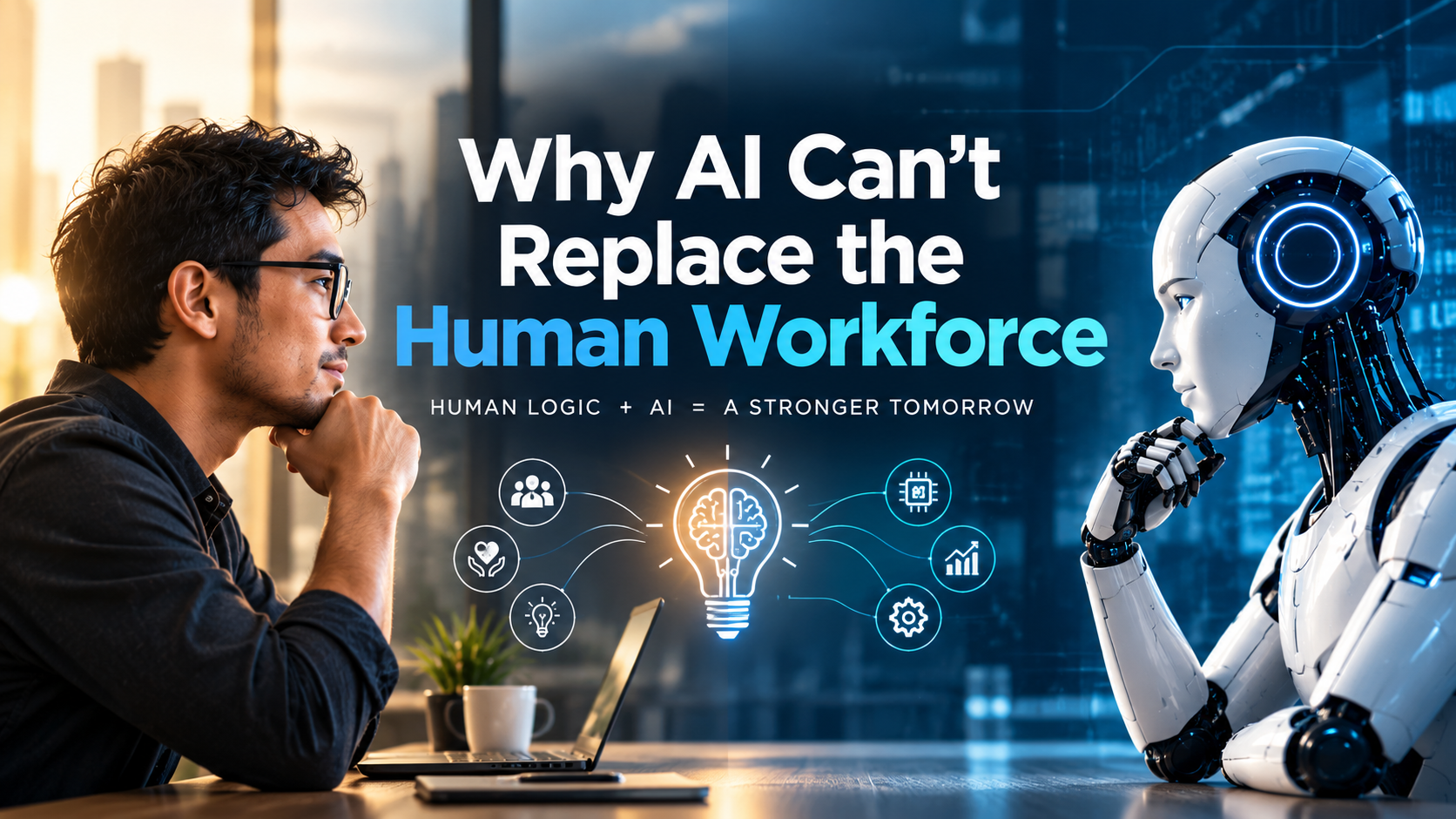
The future of work should therefore not be viewed as a competition in which humans must defeat machines to remain relevant. Instead, it should be understood as an opportunity to combine the strengths of both.
AI provides computational power and speed. Humans provide judgment, context, responsibility, and purpose.
The organizations most likely to thrive in an AI driven world will be those that understand how to bring these capabilities together rather than assuming technology can operate effectively without meaningful human involvement.
1. AI Can Process Information, but Human Logic Determines What It Means
One of the greatest strengths of artificial intelligence is its ability to process enormous quantities of information quickly. AI systems can identify patterns, summarize documents, analyze datasets, generate recommendations, and assist with decisions that would otherwise require considerable time and effort.
However, information processing and logical reasoning are not always the same thing.
AI systems generate outputs based on their training, available information, system design, and the instructions they receive. Depending on the system, they may use sophisticated reasoning techniques, but their outputs can still contain errors, unsupported assumptions, or conclusions that do not adequately reflect the real world.
Human logic provides an essential layer of evaluation.
Consider a business that uses AI to analyze customer behavior. The system might identify a decline in sales and recommend reducing prices. On the surface, that recommendation may appear reasonable because lower prices can sometimes increase demand.
A human decision maker, however, might recognize that the decline is actually caused by poor customer service, an outdated website, a change in customer preferences, or a lack of trust in the brand.
Reducing prices would not necessarily solve the real problem.
The difference lies in examining the assumptions behind a recommendation, questioning the available evidence, and understanding the broader circumstances surrounding a decision.
Human reasoning helps us ask questions such as:
- Is the information accurate and complete?
- Are we addressing the actual problem or merely its symptoms?
- What assumptions are influencing this recommendation?
- What are the possible consequences of following this advice?
- Does this solution make sense in the real world?
AI can help people explore possible answers, but its recommendations still need to be evaluated against evidence, experience, and the specific objectives of the situation.
Why critical thinking remains essential
The more accessible AI becomes, the more important critical thinking becomes.
When anyone can generate a report, business plan, marketing campaign, or technical recommendation within seconds, the value of the professional increasingly lies in knowing whether the output is correct, useful, relevant, and appropriate.
The ability to generate information is becoming easier to access. The ability to evaluate information remains a critical human skill.
2. AI Does Not Automatically Understand Human Context
Many workplace decisions involve circumstances that cannot be fully understood by looking at data alone.
A customer may complain because a product failed, but the real issue may be that the customer feels ignored. An employee may miss a deadline because of an unexpected personal emergency. A marketing campaign may perform poorly because its message conflicts with the cultural expectations of its audience.
These situations require more than identifying patterns. They require context.
Human beings interpret language, behavior, relationships, culture, and unspoken expectations through a combination of experience, social awareness, and emotional understanding.
AI can analyze sentiment, recognize contextual patterns, and generate empathetic responses. Nevertheless, it can misinterpret sarcasm, overlook subtle cultural differences, or produce a response that sounds appropriate without adequately addressing the person’s actual needs.
Imagine a customer contacting a company after receiving a defective product.
An automated system may follow a predefined process, identify the purchase, and provide the standard replacement procedure. That is useful and efficient.
However, a human support representative may recognize that the customer needs an immediate solution because the product is essential for a time sensitive event. The representative might use discretion to offer an appropriate alternative, coordinate with another department, or escalate the issue.
The strongest outcome combines both capabilities. AI handles routine information retrieval and administrative tasks, while the human representative evaluates the circumstances and makes an informed decision when the situation requires flexibility.
Efficiency answers the question of how quickly something can be done. Human judgment helps determine what should be done in the first place.
3. Emotional Intelligence Is More Than Generating an Empathetic Response
Emotional intelligence is an important part of effective leadership, teamwork, customer service, negotiation, and conflict resolution.
In professional environments, people need to recognize emotions, build trust, manage disagreements, understand different perspectives, and communicate in ways that respect the people involved.
AI can help identify emotional cues in text, suggest appropriate language, and support communication. These capabilities can be valuable, particularly when assisting professionals who need to communicate clearly and consistently.
However, generating language that resembles empathy is not equivalent to experiencing emotions or possessing human relationships.
A manager dealing with a frustrated employee must consider more than the words being spoken. The manager may need to understand the history of the situation, the employee’s working conditions, the impact on the team, and the appropriate balance between compassion and accountability.
Similarly, a healthcare professional, teacher, counselor, or customer service representative may need to respond to circumstances that demand sensitivity, discretion, and an understanding of individual needs.
Human relationships are built through trust, shared experience, accountability, and meaningful interaction.
AI can support these relationships, but organizations should be careful not to treat simulated empathy as a complete substitute for genuine human engagement.
4. Creativity Requires More Than Producing Something New
AI has become a powerful creative assistant. It can generate images, write articles, suggest business names, develop design concepts, produce music, and explore numerous variations of an idea in a short amount of time.
This has created new opportunities for artists, designers, writers, developers, and marketers.
Yet creative work is not simply the production of something that looks original.
Human creativity is influenced by personal experience, cultural identity, social change, emotion, curiosity, and the desire to communicate a particular meaning. People often create because they want to challenge conventions, express an idea, solve a problem, or change how others see the world.
AI can help explore possibilities, but the human creator still needs to determine which possibilities deserve to exist.
For example, an AI tool might generate dozens of website layouts based on a reference image. A skilled web designer must decide which layout best reflects the client’s brand, which hierarchy communicates the message effectively, which design supports accessibility, and which approach improves the user’s experience.
A visually impressive result is not automatically an effective solution.
The same principle applies to marketing. AI can generate headlines and campaign concepts, but a marketer must evaluate the audience, brand positioning, market conditions, credibility, and intended response.
The most effective creative process is therefore collaborative.
AI expands the range of possibilities. Human creativity supplies direction, interpretation, and meaningful selection.
5. AI Cannot Independently Take Human Responsibility for Its Decisions
One of the most important limitations of AI in the workplace concerns accountability.
When an AI system produces incorrect information, recommends a harmful action, or makes an inappropriate decision, someone must determine what went wrong, who was affected, and how the problem should be corrected.
AI systems do not independently assume legal, professional, or moral responsibility in the way that people and organizations can.
Responsibility remains with the humans and institutions that design, deploy, supervise, and use these systems, subject to the applicable laws and circumstances.
Consider an organization using AI to screen job applications.
An automated system might rank candidates based on information extracted from resumes. However, if the system relies on flawed criteria or historical patterns that disadvantage qualified applicants, its recommendations could contribute to unfair hiring decisions.
Human oversight can help identify inappropriate criteria, assess whether the process is fair, review unusual cases, and establish accountability for the final decision.
The same principle applies to financial services, healthcare, education, public administration, and other environments where decisions can significantly affect people’s lives.
Ethical judgment cannot be reduced to efficiency alone
A recommendation may be profitable without being fair. A process may be fast without being reliable. A technically possible action may still be inappropriate.
Human judgment helps organizations evaluate competing priorities, including:
- Fairness and equal opportunity.
- Privacy and informed consent.
- Safety and the prevention of harm.
- Transparency and accountability.
- Long term consequences for individuals and communities.
AI can assist with identifying risks and applying established rules, but people remain responsible for deciding how technology should be used and for addressing the consequences of its use.
6. Why AI Cannot Work Effectively Without Human Intervention
AI systems are often presented as autonomous solutions capable of operating independently. Some systems can indeed perform specific tasks with limited supervision, and increasingly sophisticated agents can execute multiple steps toward a defined objective.
However, autonomy within a defined environment does not mean unlimited independence.
AI systems still operate within boundaries established by their designers, data, tools, permissions, objectives, and operating conditions. Their performance can deteriorate when circumstances change, information is incomplete, or a problem falls outside the situations they handle reliably.
Human intervention remains important throughout the AI lifecycle.
A. Humans define the objectives
Before an AI system can perform a task, someone must determine what the system is supposed to accomplish.
A business might ask an AI tool to improve website conversions, reduce customer service response times, or increase operational efficiency. But these objectives require human definition.
Does improving conversions mean maximizing immediate sales, attracting qualified leads, or building long term customer relationships? Should the company prioritize short term savings or customer satisfaction?
Without clear objectives and appropriate constraints, AI may optimize a measurable outcome while overlooking the broader business goal.
B. Humans provide and evaluate information
AI outputs depend on the information available to the system and how that information is processed.
Incomplete, outdated, inaccurate, or biased data can lead to misleading results. Even when the information is accurate, it may not represent the entire situation.
Humans must determine whether the evidence is appropriate for the task, whether additional information is required, and whether the conclusions are supported by the available facts.
C. Humans validate the results
AI can generate plausible but incorrect statements, code, calculations, recommendations, or summaries.
In generative AI, this is sometimes called a hallucination: an output that is presented as factual but is unsupported or incorrect.
Human validation helps identify these problems before they affect customers, business operations, or important decisions.
The level of review should reflect the potential consequences of an error. A low risk brainstorming exercise may require limited checking, while financial reporting, security changes, or high impact decisions require more rigorous verification.
D. Humans manage exceptions and unexpected situations
No system can be assumed to anticipate every possible real world scenario.
A workflow may function correctly until a customer submits an unusual request, a website integration fails, a supplier changes its process, or new information contradicts an earlier recommendation.
Human professionals can investigate the underlying issue, adapt the process, and determine whether the AI system should continue, stop, or escalate the task.
E. Humans monitor and improve the system
Business requirements, customer expectations, regulations, and technology evolve.
AI systems therefore require appropriate monitoring, testing, maintenance, and periodic reassessment. Their performance must be evaluated against changing conditions rather than assumed to remain reliable indefinitely.
Human oversight helps ensure that automation continues to serve its intended purpose.
Taken together, these responsibilities reveal an important distinction: AI can execute tasks within a system, but humans help establish the purpose, boundaries, standards, and accountability that make the system useful.
7. AI and Human Intelligence Have Different Strengths
The argument is not that humans are better than AI at every task. Such a claim would ignore the genuine capabilities of modern technology.
AI can outperform people in specific activities, especially when tasks involve processing large amounts of structured information, identifying certain patterns, or executing repetitive operations at scale.
Humans, meanwhile, bring different strengths that become particularly important when decisions require context, accountability, adaptability, and social understanding.
The goal should be to assign responsibilities according to the strengths and limitations of each.
| Area | What AI contributes | What humans contribute |
|---|---|---|
| Data analysis | Rapid processing and pattern identification | Interpretation, verification, and strategic decisions |
| Content creation | Drafts, variations, and idea generation | Original direction, editorial judgment, and audience understanding |
| Customer service | Routine answers and information retrieval | Empathy, discretion, and complex problem resolution |
| Software development | Code suggestions, testing assistance, and debugging support | Architecture, security judgment, requirements, and validation |
| Decision making | Predictions, scenarios, and recommendations | Context, tradeoffs, accountability, and final judgment |
| Leadership | Reporting, planning support, and workflow automation | Trust, motivation, conflict resolution, and responsibility |
| Innovation | Exploration of possible solutions | Purpose, experimentation, real world insight, and direction |
The strongest arrangement is not necessarily one in which humans perform every task or AI performs every task. It is one in which each contributes where it can add the most value.
8. How Human and AI Collaboration Can Transform the Workplace
The benefits of AI become clearer when it is integrated into actual professional workflows.
Website development and digital marketing
AI can assist with generating code, drafting website copy, identifying technical issues, analyzing search trends, and suggesting design variations.
However, a web professional must still understand the client’s objectives, organize the user experience, validate functionality, protect website security, check accessibility, and ensure the final result meets business requirements.
A generated website can look impressive in a demonstration and still contain broken forms, inaccessible components, poor mobile behavior, insecure configurations, or confusing navigation.
AI can accelerate development, but professional expertise helps turn a generated output into a reliable business solution.
Healthcare
AI can help analyze medical images, summarize records, and identify patterns that warrant further investigation.
Qualified healthcare professionals must interpret findings within the patient’s circumstances, consider relevant evidence, communicate with the patient, and make clinical decisions within their professional responsibilities.
AI assistance can improve aspects of care, but it should not be treated as an unquestionable authority.
Education
AI can help teachers develop lesson plans, create practice questions, and provide additional explanations for students.
Teachers remain essential for recognizing individual learning needs, motivating students, supporting social development, and evaluating progress within the wider educational context.
The objective should be to improve teaching and learning, not merely to automate the delivery of information.
Business operations
AI can support inventory forecasting, reporting, customer segmentation, and administrative workflows.
Human managers still need to consider operational realities, employee impact, customer expectations, business risks, and strategic priorities.
The result can be a more efficient organization without eliminating the need for responsible leadership.
Creative industries
Designers, writers, musicians, and marketers can use AI to explore concepts, develop rough drafts, and accelerate repetitive production tasks.
Human professionals contribute the artistic direction, cultural relevance, originality of intent, and final quality control that distinguish useful creative work from output that merely looks complete.
Across these industries, the same principle applies: AI is most valuable when its capabilities are integrated into a thoughtfully designed human workflow.
9. The Real Risk Is Not AI Itself, but the Misuse of AI
It would be misleading to claim that AI will never replace human jobs.
Some tasks and certain job roles will be automated, and some organizations may reduce hiring or restructure their workforces as a result. The impact will vary by industry, occupation, business model, and the pace of adoption.
Many jobs consist of multiple activities rather than a single task. AI may automate certain activities while increasing demand for other responsibilities, changing the skills required, or creating entirely new ways of working.
This means the future of employment is not simply a choice between complete replacement and complete protection.
A major risk emerges when organizations adopt AI primarily to reduce costs without evaluating the long term consequences.
Poorly implemented automation can introduce errors at scale, weaken customer relationships, create security vulnerabilities, reduce institutional knowledge, and make businesses overly dependent on systems that employees do not fully understand.
There is also a danger in treating AI generated information as automatically correct or assuming that technological sophistication eliminates the need for expertise.
The responsible approach is to identify which tasks benefit from automation, where human judgment is essential, and how employees can be supported as their roles evolve.
Organizations should invest in training, establish clear oversight procedures, protect sensitive information, and evaluate AI systems based on measurable improvements in quality, safety, and productivity.
The objective should not be to automate everything that can technically be automated. It should be to use technology in ways that produce better outcomes for people and businesses.
10. The Human Workforce Must Evolve Alongside AI
As AI becomes more capable, professionals will need to adapt.
However, adapting does not mean abandoning human expertise. It means strengthening the skills that help people work effectively with increasingly powerful tools.
Several capabilities are especially important.
Critical thinking and logical reasoning. Professionals must learn to question outputs, evaluate evidence, identify contradictions, and distinguish reliable conclusions from unsupported claims.
AI literacy. Employees need to understand how AI tools work at a practical level, what they are good at, where they can fail, and when their outputs require additional verification.
Communication and collaboration. As automation handles more routine activities, clear communication, relationship building, negotiation, and teamwork remain important for coordinating people and technology.
Creativity and problem solving. Professionals should learn to use AI to explore possibilities while developing their ability to define meaningful problems and choose effective solutions.
Ethics and accountability. Workers and leaders must recognize privacy concerns, potential bias, security risks, and the human consequences of automated decisions.
Continuous learning. Tools and workflows will continue to change. The ability to learn, experiment, and adapt will be essential to remaining effective in an evolving workplace.
These skills are not valuable only because they are difficult to automate. They are valuable because they help people direct technology toward meaningful goals.
The future belongs neither exclusively to people who avoid AI nor exclusively to people who rely on it for everything. It will favor professionals who understand how to use AI effectively while maintaining the judgment and expertise necessary to evaluate its results.
11. Building a Workplace Where Humans and AI Coexist
Successful human and AI collaboration does not happen automatically. It requires deliberate decisions about responsibilities, processes, and organizational culture.
Businesses can begin with a few practical principles.
1. Automate repetitive tasks, not accountability.
Use AI to reduce administrative work, accelerate information retrieval, and handle predictable processes. Keep clear responsibility for decisions that affect people, safety, finances, reputation, or legal obligations.
2. Keep humans involved where judgment matters.
Establish review and escalation procedures for ambiguous, unusual, or high impact situations. Human involvement should be meaningful rather than a superficial approval step.
3. Verify before trusting.
Test AI generated content, calculations, recommendations, and code according to the risk involved. Define clear standards for accuracy and quality.
4. Invest in employees.
Provide practical training so employees can use AI confidently, recognize limitations, and develop skills that complement automation.
5. Protect data and privacy.
Set clear rules for handling confidential information, personal data, business records, and intellectual property. Choose tools and permissions that match the organization’s security requirements.
6. Measure outcomes, not just speed.
Evaluate whether AI actually improves accuracy, customer satisfaction, accessibility, productivity, and business performance. Faster output is not necessarily better output.
7. Design for collaboration.
Give employees tools that help them make better decisions rather than forcing them to work around poorly designed automation. Invite feedback from the people who use these systems every day.
By following these principles, businesses can build a workplace in which AI supports human capabilities instead of weakening the expertise on which the organization depends.
12. The Future of Work Is Human Guided, AI Powered
The history of technological progress shows that new tools can change how work is performed. Mechanization transformed manufacturing, computers transformed information processing, and the internet transformed communication and commerce.
Artificial intelligence represents another major shift, with the potential to affect a wide range of occupations and industries.
But the significance of a technology is not determined by its capabilities alone. It also depends on how people choose to use it.
AI can help organizations work faster, explore new ideas, analyze information, and make certain processes more efficient. Humans determine which problems deserve attention, what outcomes matter, how competing priorities should be balanced, and what responsibilities must be upheld.
A business that relies entirely on AI without sufficient oversight risks confusing automation with understanding. A business that refuses to use AI may miss opportunities to improve productivity and empower its workforce.
Neither extreme represents the full potential of this technology.
The more productive approach is to combine machine efficiency with human intelligence, allowing each to compensate for the other’s limitations.
This is not about protecting every existing task from automation. It is about ensuring that technological progress creates meaningful value while preserving the human judgment, expertise, and accountability needed to use it responsibly.
Conclusion: AI Is a Tool. Human Intelligence Gives It Direction.
Artificial intelligence is not merely a passing trend. It is becoming an important part of how modern organizations operate, innovate, and compete.
Its ability to automate tasks, process information, and generate solutions will continue to create new opportunities and challenges for the workforce.
Yet the ability to perform a task does not automatically confer the ability to understand its full human significance, determine its ethical implications, or accept responsibility for its consequences.
That is why human logic remains essential.
People question assumptions, interpret context, weigh consequences, understand relationships, and make decisions based on values and experience. AI can support these activities, but its outputs still need to be evaluated within the real world in which people live and work.
The future should not be defined by a struggle between human intelligence and artificial intelligence.
It should be defined by how effectively the two work together.
AI brings speed, scale, and computational power. Humans bring reasoning, empathy, creativity, and responsibility. Together, they can accomplish more than either could achieve as effectively on its own.
The goal is not to build a world where machines replace people wherever possible. It is to build a world where technology empowers people to solve better problems, make better decisions, and create better outcomes.
Because the true measure of artificial intelligence is not simply how much it can do without us.
It is how much better we can do when we use it wisely.
The future of work is not AI replacing humanity. It is humanity learning how to make AI work for us.