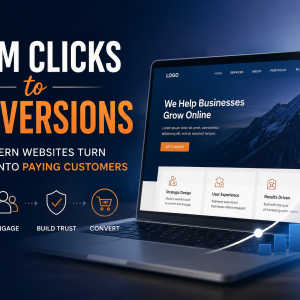

From Clicks to Conversions: How Modern Websites Turn Visitors into Paying Customers
Introduction: Traffic Alone Doesn’t Grow a Business
In 2026, getting website traffic is easier than ever—ads, social media, SEO, and AI search can all bring visitors to your site. But traffic alone does not guarantee revenue.
The real question is: how many of those visitors actually become paying customers?
This is where modern websites have evolved. They are no longer just digital brochures—they are conversion systems built to turn attention into action.
1. The Shift From Websites to Conversion Systems
Old websites were built to “show information.”
Modern websites are built to guide decisions.
Instead of just saying what a business does, high-performing websites now:
- Lead visitors through structured journeys
- Answer objections before they are asked
- Build trust within seconds
- Push users toward clear actions
Every click is now part of a designed path toward conversion.
2. First Impressions Decide Everything
Visitors form an opinion about your website in under 3 seconds.
If your site feels outdated, slow, or confusing, users leave immediately—no matter how good your service is.
Modern high-converting websites focus on:
- Clean and modern design
- Strong visual hierarchy
- Clear messaging above the fold
- Fast loading speed on mobile
A website doesn’t get a second chance at a first impression.
3. The Psychology Behind Conversions
Conversions don’t happen by accident—they happen through psychology.
Successful websites use:
A. Trust Signals
- Testimonials
- Client logos
- Case studies
- Real project photos
B. Clarity
Visitors should understand within seconds:
- What you do
- Who it’s for
- Why it matters
C. Reduced Friction
- Simple forms
- Clear call-to-actions
- Fewer unnecessary clicks
When confusion drops, conversions rise.
4. The Role of Structure in Turning Clicks into Customers
A modern website is carefully structured like a sales funnel:
- Landing (Attention)
- Hero section with clear value proposition
- Engagement (Interest)
- Benefits, services, visuals
- Proof (Trust)
- Reviews, portfolios, results
- Action (Conversion)
- Contact forms, booking buttons, checkout options
Every section has one goal: move the visitor closer to a decision.
5. Speed and Mobile Experience = Revenue
In 2026, more than half of users browse on mobile devices. If your website is slow or hard to navigate, you are losing money instantly.
High-performing websites prioritize:
- Mobile-first design
- Fast loading pages
- Lightweight structure
- Optimized images and scripts
Even a 1-second delay can reduce conversions significantly.
6. Why WordPress + Elementor Still Dominates Conversion Websites
Platforms like WordPress combined with Elementor remain the top choice for building conversion-focused websites because they offer:
- Full design control without coding limitations
- Fast deployment of landing pages and funnels
- Integration with CRM, email, and marketing tools
- Scalable structure for future growth
This combination allows businesses to build websites that are not just beautiful—but profitable.
7. Common Reasons Websites Fail to Convert
Most websites lose customers because of:
- Unclear messaging
- Weak or missing call-to-action
- Poor mobile experience
- Too much information at once
- Lack of trust signals
A website doesn’t fail because of traffic—it fails because of structure and clarity.
Conclusion: Clicks Are Easy, Conversions Are Engineered
Modern websites are no longer static pages. They are carefully engineered systems designed to convert attention into action.
Businesses that understand this shift will consistently outperform those who still treat their website as just an online brochure.
In 2026 and beyond, success belongs to websites that don’t just attract visitors—but convert them into customers.